


For many children, difficulty with learning is not simply about ability, intelligence or curriculum.
A child may be bright and capable but still feel anxious, exhausted, overwhelmed or reluctant to participate. They may avoid writing, stop asking questions, fear getting things wrong or gradually disconnect from learning altogether.
When children feel safe, known and accepted, something important changes. They are more able to ask questions, make mistakes, try again, share ideas and take the small risks that meaningful learning requires.
At Lions Homeschool Hub, this is why we believe belonging comes before learning.
Not because academics are unimportant, but because learning matters too much to ignore the conditions children need in order to engage with it.
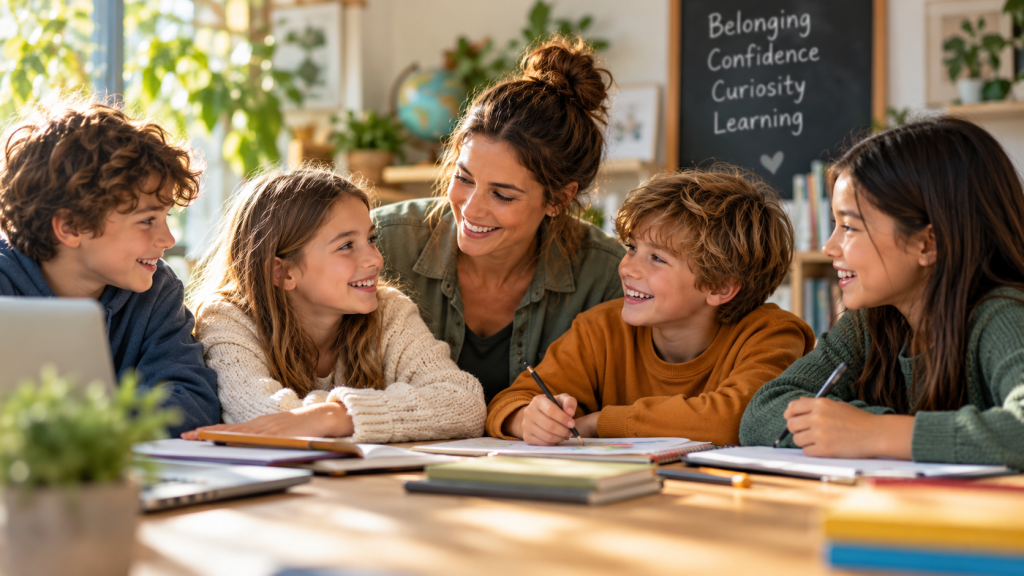
Why Does Feeling Safe Matter for Learning?
Children learn best when they have a supportive environment in which they feel safe enough to participate, make mistakes and attempt challenging work.
Emotional safety does not mean removing every difficulty or making learning easy. It means creating an environment in which a child can face difficulty without feeling threatened, humiliated or afraid of failure.
The Australian Education Research Organisation’s research on how students learn best explains that learning requires focused attention and active engagement within a supportive and responsive learning environment. It also notes that students who feel supported and have a positive sense of belonging within their learning community are more actively engaged in learning.
Research into school belonging supports this connection. A longitudinal study examining school belonging and academic achievement involving more than 8,000 observations found strong evidence that a child’s sense of school belonging can influence later academic achievement.
That matters because learning requires participation.
A child has to be willing to say, “I don’t understand.”
They have to be willing to attempt the maths problem they might get wrong.
They have to be willing to read aloud, offer an idea, write the first imperfect sentence or contribute to a discussion.
Those are academic actions, but they are also relational risks.
A child who constantly feels judged, pressured or unsafe may naturally become more cautious. A child who feels respected and supported has more room to explore.
Emotional Safety Does Not Mean Removing Challenge
A safe learning environment should never mean a learning environment without expectations.
Children still need structure, guidance, feedback, responsibility and appropriately challenging work.
The difference is in how that challenge is experienced.
When challenge takes place within a relationship of trust, children can learn that struggling with something does not mean they have failed. They can ask for help, receive feedback, try another approach and keep going.
This is one reason we believe emotional safety and academic growth should not be treated as competing priorities.
Children need both.
They need to know:
“I am safe here.”
“I am allowed to ask questions.”
“I can make a mistake.”
“I can try again.”
“My ideas matter.”
“And the people teaching me want me to succeed.”
That is the kind of environment in which genuine learning can grow.
Belonging Helps Children Re-Engage With Learning
Many families come to Lions after learning has become difficult for their child.
Some children arrive anxious or exhausted. Others have become quiet, resistant or completely disengaged. Some have experienced bullying, social pressure or a learning environment that simply did not suit the way they learn.
These children are not necessarily incapable of learning.
Sometimes they have simply stopped believing that learning is a safe place for them.
Belonging can begin to change that.
When children feel known by their educators and accepted by their peers, they do not have to spend as much energy trying to protect themselves socially or emotionally.
Gradually, participation can return.
The child who avoided writing may begin sharing an idea.
The child who rarely spoke may contribute to a discussion.
The child who was afraid of being watched may eventually present something they created.
The child who always felt different may discover other children who understand them.
These changes can appear small from the outside. But for a child who has withdrawn from learning, they can be significant steps forward.
Families considering home education may also face questions about isolation, motivation, socialisation and academic responsibility. Our guide to homeschooling challenges and solutions explores some of these concerns and practical ways families can respond to them.
Relationships Are Part of the Learning Environment
Children do not learn from curriculum alone.
They learn through relationships with people who know them, challenge them, encourage them and notice when something is wrong.
That is why relationships sit at the heart of the Lions approach.
Although much of our learning happens online, our students are not simply names appearing on a screen.
Our educators get to know their interests, strengths, learning needs, humour, creativity and personalities.
Smaller learning groups also make it easier for educators to notice when a child needs clarification, encouragement or additional support.
Over time, consistency helps build trust.
And trust makes it easier for children to participate.
Families can learn more about why Lions Homeschool Hub exists and the people behind our learning community.
Can Online Homeschooling Still Create Real Belonging?
Yes. Online learning and genuine social connection do not have to be opposites.
A well-designed online homeschooling community can give children regular opportunities to talk, collaborate, create, solve problems and build friendships with other students.
At Lions, live online learning is combined with opportunities for genuine community.
Students learn together during the week, work on integrated learning activities and participate in creative projects. Relationships formed online can also continue through meetups, excursions, camps and other shared experiences.
This matters because homeschooling should not have to mean learning alone.
Children still need friendship, collaboration, conversation and the experience of being part of something larger than themselves.
Parents need community too.
One of the most valuable parts of homeschooling can be finding other families who understand both the challenges and possibilities of choosing a different educational path.
Our guide to building connections within the homeschooling community explores how families can find support and develop meaningful relationships while homeschooling.
Why Small-Group Learning Can Help
Large learning environments work well for many children.
For others, they can feel overwhelming.
Some children participate more confidently when there are fewer people watching them, when they know the other students well and when an educator has enough time to understand how they learn.
Smaller groups can provide more opportunities to ask questions, receive feedback, contribute to discussions and work collaboratively.
At Lions, students are supported in smaller learning groups, with learning designed around student needs rather than assuming every child of the same age must learn in exactly the same way.
Our homeschooling FAQs explain more about our learning groups, educator-to-student ratios, curriculum, socialisation and approach to supporting individual learners.
The goal is not to remove challenge.
It is to create the conditions in which children are more willing to meet it.
Children Need Connection as Well as Curriculum
Academic content matters.
So do literacy, numeracy, knowledge, skills and disciplined thinking.
But children are more than academic outcomes.
They also need opportunities to laugh, create, move, talk, cook, build, play, collaborate and develop friendships.
This is why meaningful projects and community experiences are an important part of learning at Lions.
Through our integrated homeschool curriculum, students explore ideas across different learning areas rather than experiencing every subject as an isolated task.
Each term is built around an integrated unit of study, with literacy, mathematics, science, humanities, creative subjects and other learning areas connected through meaningful questions and experiences.
This approach allows students to see how knowledge connects.
Instead of simply asking, “Why do I have to learn this?”, they can begin to understand how different skills and ideas work together.
Learning Becomes Meaningful Through Projects
One important part of this approach is Project Day at Lions Homeschool Hub.
Students work towards meaningful projects that give their learning a purpose. Depending on the unit, they may research, design, write, create, solve problems, collaborate, communicate and present their work.
Project-based learning allows students to use academic skills rather than simply complete disconnected exercises.
They learn how to stay with an idea, respond to feedback, solve problems and turn their thinking into something tangible.
Learning becomes something they participate in rather than something that is simply delivered to them.
What Should Parents Look for in a Supportive Learning Environment?
A good learning environment should make it possible for children to grow both academically and personally.
Parents can look beyond curriculum documents and ask deeper questions:
- Does my child feel known by the people teaching them?
- Can they ask for help without embarrassment?
- Are mistakes treated as part of learning?
- Are expectations clear and consistent?
- Does the environment encourage curiosity?
- Is there genuine interaction with educators and other children?
- Is my child appropriately challenged without constantly feeling overwhelmed?
- Does my child have opportunities to contribute, create and develop confidence?
No educational environment will be perfect for every child.
But the right environment should help a child move towards greater curiosity, confidence, responsibility and engagement rather than continually withdrawing from learning.
What If My Child Is Experiencing School Anxiety or School Refusal?
Persistent anxiety or school refusal can have many causes, including learning difficulties, bullying, social challenges, stressful experiences and mental health concerns.
The Raising Children Network’s guidance on school refusal explains that children may struggle to attend school for many different reasons, including anxiety, learning difficulties, social challenges, negative school experiences or bullying.
For some families, changing the learning environment may form part of a broader decision about what is best for their child.
However, homeschooling should not automatically be viewed as a treatment for anxiety.
Where anxiety, distress or school refusal is persistent or significantly affecting a child’s wellbeing, parents should seek appropriate professional advice and consider the child’s needs as a whole.
The goal is not simply to avoid everything that feels difficult.
It is to understand what the child needs and find an environment in which healthy learning, confidence and development can begin again.
How Lions Creates a Safe and Connected Homeschooling Community
Lions Homeschool Hub is not a registered school. We are a supportive learning community that works alongside homeschooling families.
Students remain registered for homeschooling through the appropriate state or territory authority, while Lions provides structured learning support, qualified educators, live interactive sessions and opportunities for community and connection.
Our approach combines academic support with the belief that children learn more effectively when they feel respected, known and genuinely included.
For some children, that can make a profound difference.
The child who once dreaded learning may begin asking questions again.
The child who felt invisible may discover that people notice when they arrive.
The child who was afraid of making mistakes may learn that getting something wrong is simply part of learning something new.
And the child who felt they never quite fitted in may finally experience what it means to belong.
Belonging Is Not an Extra
Belonging is not something we add after the “real learning” is finished.
It helps create the conditions in which real learning can take place.
Children still need excellent teaching.
They still need clear expectations.
They still need knowledge, practice, feedback and challenge.
But these things work best within an environment where children feel safe enough to participate, known enough to ask for help and secure enough to keep trying when something is difficult.
At Lions, that is the kind of learning community we are working to build.
Because children learn best when they feel connected.
They learn best when they feel safe.
And they learn best when they know they matter.
Frequently Asked Questions
Why do children learn better when they feel safe?
Feeling safe and supported can make it easier for children to focus, participate, ask questions, make mistakes and attempt challenging work.
Research from the Australian Education Research Organisation identifies supportive learning environments, positive relationships and a sense of belonging as important conditions for active student engagement.
What is emotional safety in education?
Emotional safety means a child feels respected, accepted and able to participate without constant fear of ridicule, rejection or humiliation.
It does not mean removing expectations or challenge.
A healthy learning environment combines emotional safety with appropriate structure, guidance, feedback and academic challenge.
Does a Sense of Belonging Affect Academic Learning?
Research suggests that it can.
A longitudinal study of school belonging and academic achievement found evidence that students’ earlier sense of belonging predicted later academic achievement.
Belonging can also influence engagement, motivation, participation and willingness to persist when learning becomes difficult.
Can Homeschooling Help a Child Who Is Anxious About School?
Homeschooling provides a different educational environment and may suit some children and families.
However, persistent anxiety or school refusal can have many causes. Families should consider the child’s broader needs and seek appropriate professional guidance when anxiety or distress is significant.
How Can Homeschooled Children Develop Friendships?
Social connection can happen through online learning communities, homeschooling groups, extracurricular activities, excursions, camps, sports, clubs and regular meetups.
At Lions, students interact through live online sessions as well as community activities and face-to-face opportunities.
Read more about social connection and community for homeschooling families.
Is Lions Homeschool Hub a School?
No.
Lions Homeschool Hub is a supportive learning community for homeschooling families rather than a registered school.
Parents remain responsible for their child’s homeschooling registration, while Lions provides educational support, qualified educators, live learning and community.
You can find more details on our Frequently Asked Questions page.
Find Out Whether Lions Is Right for Your Child
If your child has become anxious, overwhelmed or disconnected from learning, the environment around them is worth examining.
Lions supports homeschooling families through live interactive learning, smaller groups, qualified educators, an integrated approach to learning and a community built around genuine connection.
Every child is different, and we take the fit between a child, their family and the Lions community seriously.
Register your interest with Lions Homeschool Hub to speak with our team, tell us about your child and explore whether our approach could be the right fit for your family.